
الجراحة
التعقيم
ما يحدث أثناء عملية التعقيم، والمشكلات الصحية التي تمنعها، وكيف تغيّر العملية سلوك الكلاب والقطط.
الكلابالقطط
اقرأ على الموقع (بالإنجليزية)
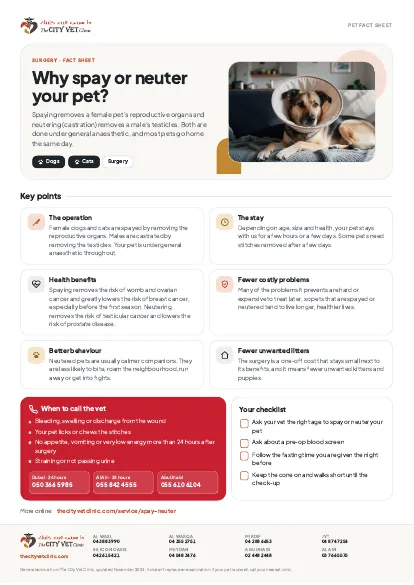
Spaying removes a female pet's reproductive organs and neutering (castration) removes a male's testicles. Both are done under general anaesthetic, and most pets go home the same day.
النقاط الأساسية
- The operation. Female dogs and cats are spayed by removing the reproductive organs. Males are castrated by removing the testicles. Your pet is under general anaesthetic throughout.
- The stay. Depending on age, size and health, your pet stays with us for a few hours or a few days. Some pets need stitches removed after a few days.
- Health benefits. Spaying removes the risk of womb and ovarian cancer and greatly lowers the risk of breast cancer, especially before the first season. Neutering removes the risk of testicular cancer and lowers the risk of prostate disease.
- Fewer costly problems. Many of the problems it prevents are hard or expensive to treat later, so pets that are spayed or neutered tend to live longer, healthier lives.
- Better behaviour. Neutered pets are usually calmer companions. They are less likely to bite, roam the neighbourhood, run away or get into fights.
- Fewer unwanted litters. The surgery is a one-off cost that stays small next to its benefits, and it means fewer unwanted kittens and puppies.
متى تتصل بالطبيب البيطري
- Bleeding, swelling or discharge from the wound
- Your pet licks or chews the stitches
- No appetite, vomiting or very low energy more than 24 hours after surgery
- Straining or not passing urine
دبي 24 ساعة 050 366 5985 · العين 24 ساعة 055 842 4555 · أبوظبي 24 ساعة 055 610 6104
قائمة التحقق
- Ask your vet the right age to spay or neuter your pet
- Ask about a pre-op blood screen
- Follow the fasting time you are given the night before
- Keep the cone on and walks short until the check-up